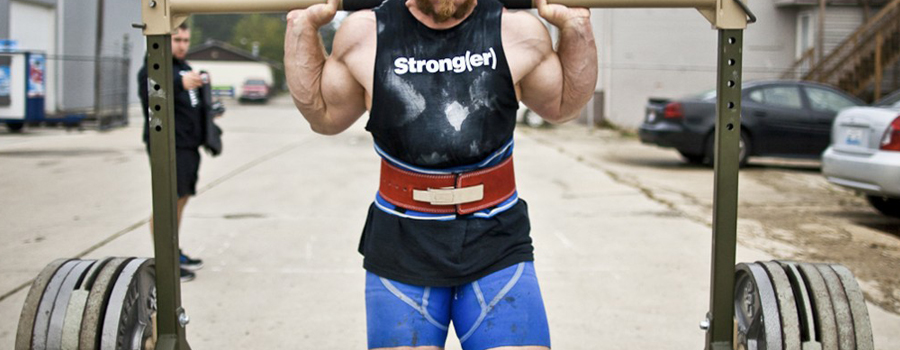
Strongman - A true test of strength.
In the early days of Strongman terminology a “Strongman” was described as someone who was an exhibitor of pure strength used as circus performers. These days whilst still entertaining to watch, Strongman events are an exhibition of true athleticism and strength endurance with competitions are held all over Australia.
Not unlike an athlete maxing out for a one rep lift. Now Strongman Training has evolved into a sport on its own. A sport of strength and endurance. The beauty of Strongman is that there is no set of rules, no set number of events and not even a universal technique to do each individual event. Its non-uniformity is also what makes it the best way to train for applied Functional Strength (that is the strength that transfers to places outside of a weight room, like a football field or wrestling mat).
The days of the one rep max are gone and in its place is an endurance factor that when combined with lifting heavy weights results in a dangerously effective training technique and the pinnacle of applied Functional Strength. A conversion factor that is arguably ignored in power lifting, body building and other strength based sports.
In strongman competitions a winning Strongman Athlete is often times not the strongest, but the most well rounded in weight to strength and endurance, well prepared across all areas, and a mentally sturdy athlete in the competition.
Strongman Training won’t just make you strong on one lift it will make you all-round complete as a strong athlete. For athletes of any fitness level and experience wanting to experience Strongman training you can start with the follow strongman exercises.
The Yoke Walk
The Yoke Walk is an awesome test of complete body strength, conditioning and mental fortitude.
The yoke itself a simple yet wicked implement. It is usually an “H” shaped device made of steel box section, with a tubular crossbar that sits on your upper back much like a squat bar. It is loaded up to 2x, 3x or even 4x bodyweight, and the athlete walks a distance with the weight crushing down on him or her.
Like a squat, the yoke walk requires a strong posterior chain, a strong abdominal region and a strong upper back. The fact that the athlete walks with the weight multiplies the training effect on these areas, as well as being a brutal test of an athlete’s conditioning and mental fortitude.
The yoke walk has a few variants in competition, in particular the car walk, where the body of a car, sans roof and floor, replace the yoke implement. The practicalities of manufacturing and storing a car effectively preclude this alternative from all but competition use.
A sample training regime for the yoke walk may be
Week 1 : Work up to a heavy yoke for 15m distance doing multiple runs adding 40-80kg each time, resting between each one ~5 minutes.
Week 2 : Work up to 60% of max yoke, working with higher volumes, longer distances ~25m and shorter rest times ~2 minutes.
The yoke walk is a great training tool for athlete’s looking to increase their conditioning and mental toughness, and it is a great tool to implement in a team training environment. As well as being easily scaled to different experience levels via weight loading/unloading, distance and rest times.
The Farmers Walk
The farmers walk is a traditional strongman event that can be traced back to Scottish Heavy Athletics from centuries ago. It’s a very simple event – an athlete picks up a heavy weight in each hand and walks with it, sounds simple right...?
The farmers walk is a test of the posterior chain, the abdominals and upper back. In particular, it is a huge test of grip and forearm strength, and this is the area most novice athletes fail in this movement.
To train the farmers walk, it’s important to cover various distances between 10-30 metres, and to practice the pickup and turns. The pickups will test your posterior chain like a deadlift, however due the mechanically advantageous starting position of your hands by your side, many athletes find they can pick up famers walk implements that (combined) are heavier than their maximum deadlift. Turns will load your grip and stabiliser muscles exponentially.
A sample training regime for the farmers walk may be
Week 1: Work up to a heavy farmers walk for 15m (doing multiple runs adding 20-40-kg each time, resting between each one ~5 minutes.
Week 2: Work up to 60% of max farmers walk, working with higher volumes, longer distances ~25m and shorter rest times ~2 minutes.
The farmers walk is complementary for the yoke, and Strongman athletes often choose to train heavy yoke/ light farmers walk one week, and light yoke/heavy farmers the next.
The farmers walk is great for athletes who rely on grip and forearm strength in their chosen sport such as tackling or MMA.
Strongman recovery
As with any athlete needing muscle recovery foods rich in protein, quality carbohydrate and good fats are key. Most strongman athletes aren’t overly concerned with body weight unless competing in a weight restricted event. Body Bodybuilding Supplements are also extensively used by strongman athletes to ensure they receive adequate recovery. Creatine Monohydrate is also big with strongman athletes for the increased ATP energy performance, quick recovery and explosive energy.